Have you previously sprained your ankle, recovered, and then found you sprained it again? You may be experiencing ankle instability.
Ankle sprains are one of the most common musculoskeletal injuries we see, especially within the active and sporting population. While many people recover well following a sprained ankle, poor rehabilitation can increase your risk of further ankle sprains down the line. Understanding why your ankle keeps giving way is one of the first steps towards breaking the cycle.
What is an ankle sprain?
An ankle sprain corresponds to the stretching or tearing of one or more of the ligaments in the ankle joint [1] which usually occurs when the foot rolls beyond its normal range. A ligament is a tough band of connective tissue which connects bones to other bones, to provide movement and stability to the joint.
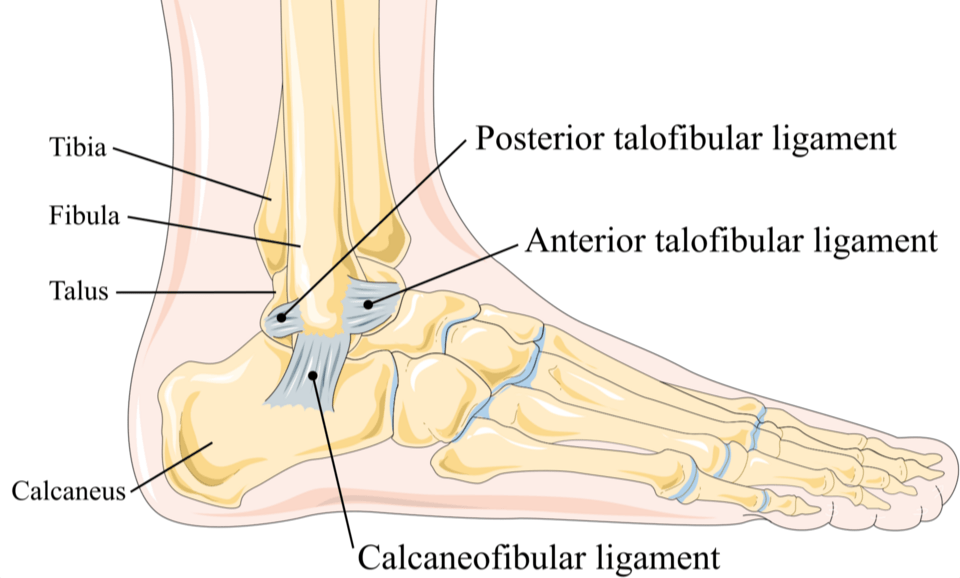
There are many ligaments in the ankle, but the lateral ankle ligaments standout as the most frequently injured during an ankle sprain, with almost an 85% incidence rate [2]. The lateral ankle ligament complex is made up of the anterior talofibular ligament (ATFL), calcaneofibular ligament (CFL) and posterior talofibular ligament (PTFL) which aim to provide stability against ankle inversion (where the bottom of the foot turns inwards) [3]. Out of the three lateral ligaments, the ATFL is the most commonly injured, present in 66-85% of these injuries [4].
Common symptoms following an ankle sprain include pain, swelling, bruising, restricted range of motion and difficulty weight bearing. With time, these symptoms do improve, some quicker than others depending on the severity of the sprain. However, in some cases the ankle may not have fully regained its full strength, movement or proprioception which is where recurrent sprains can become a problem.
Why does my ankle keep giving way?
It is rare for there to be one single cause of repeated ankle sprains, instead it usually is a combination or multiple factors. Here we will explore some of the factors but please note there is more.
- Limited ankle range of movement
Following an ankle sprain, a loss of range of motion is a common occurrence which can be contributed to by swelling, pain or muscle guarding. Reduced ankle mobility, especially dorsiflexion (bringing your toes up towards your shin), can affect the way you walk, run, jump and squat.
This reduction can alter your body’s biomechanics and distribution of forces favouring compensatory movement strategies, which elevates your risk of ankle sprain recurrence [5].
- Reduced balance and proprioception
Proprioception is the body’s natural ability to sense the position of a joint and how it moves. When this is impaired, your body loses its ability to control this sense and so as a result the ankle will experience poor balance, uncoordinated movements and clumsiness.
Studies have shown that this impairment in proprioception increases an individual’s chances of re-spraining their ankle [6, 7], and so it is important that balance exercises form a part of your rehabilitation programme to reduce this risk.
- Weakness in the ankle and leg muscles
The muscles around your ankle and lower leg are key following an ankle sprain as these will assist to control movement and protect the joint.
Asymmetries in these lower limb muscles have been identified as risk factors for recurrent ankle sprains due to the reduction in ability to stabilise the ankle during running, jumping or change of direction. Core weakness may also contribute to recurrent ankle sprains. When the core is weak, the body may rely on compensatory movements to maintain balance placing additional stress on the ankle [7].
- Returning to sport too quickly
Following an ankle sprain, the ligaments need sufficient time to recover. For many people, once pain has ‘disappeared’, it is seen as a green light to return back to sport. However, this does not mean the ankle has completely recovered, you may still lack strength, balance and neuromuscular control for high demand activities.
A rapid return to sport which lacks objective testing is likely to increase the risk of reinjury [8, 9]. Rehabilitation must gradually build from basic movements to challenging hops, jumps and changes of direction to match the requirements of competitive play.
What is Chronic Ankle Instability?
Chronic ankle instability (CAI) is defined as a “condition in which an individual has a significant ankle sprain and/or experienced recurrent ankle sprain on the sprained ankle, and/or feels ankle instability, and/or experienced giving way at least twice in the past six months” [10]. It is thought that about 20% of acute lateral ankle sprain patients go on to develop CAI [11]. For people suffering from CAI, it is common for them that their ankle feels unreliable during everyday activities such as walking on uneven ground or completing the stairs but also during sports. Many people continue to face discomfort, swelling and reduced confidence [12].
Preventing the progression of CAI is important to not only reduce the risk of recurrent ankle injuries, but also to minimise potential consequences. CAI has been associated with early development of osteoarthritis and increased loading on the anterior cruciate ligament (ACL) [10], both consequences we want to limit.
How can physiotherapy help?
Physiotherapy is essential in the early days of post acute ankle sprain, through to late-stage rehabilitation, while also helping to identify and address factors that may contribute to recurrent ankle sprains.
An initial physiotherapy assessment will involve identifying the mechanism of injury, palpation, swelling observation, range of motion measuring, strength testing, special tests, balance, gait analysis and functional movements [2].
Based upon the assessment, a personalised rehabilitation plan will be developed to target your individual needs. In general a rehabilitation programme will include:
- Range of motion exercises to restore normal ankle movement [13]
- Strengthening exercises for the ankle, calf, lower limb muscles and core [14].
- Proprioception training such as utilisation of wobble boards [15] to improve joint control
- Plyometric exercises to retrain the ankle to the requirements of hopping and landing
- Sport specific exercises to prepare individuals for running, jumping and change of direction [16].
- Education and advice on gradually returning to activity and reducing further injury risk.
Effective rehabilitation will focus on helping you regain mobility, strength, control and confidence in your ankle. It is essential that your rehabilitation includes objective testing to monitor lower limb strength to identify any weaknesses or asymmetries as we know this may contribute to an increased risk of recurrence [7].
Key Points and Roundup
Breaking the cycle of recurrent ankle sprains is essential to prevent them from becoming a long-term, frequent problem. With the appropriate, evidence-based and objective rehabilitation, many individuals can improve their strength and neuromuscular control to return confidently to their activities and sporting demands, with a lower risk of recurrence.
If your ankle keeps ‘rolling’ or ‘giving way’, do not ignore it. This can be a sign that your ankle needs targeted rehabilitation to overcome this.
Our Barnet, Cockfosters & Enfield Physio’s have tons of experience and are specialists in treating all types of ankle injuries . Have confidence that our specialist Physiotherapists will closely assess, diagnose & treat you in the correct & evidence-based way for all injuries. You can book an appointment here.
Blog By: Jess Simmons (Specialist Musculoskeletal Physiotherapist at Crouch Physio).
References
- Zahra, W., Meacher, H. and Heaver, C. (2024) ‘Ankle sprains: A review of mechanism, pathoanatomy and management’, Orthopaedics and Trauma, 38(1), pp. 25–34. doi:10.1016/j.mporth.2023.11.005.
- Halabchi, F. and Hassabi, M. (2020) ‘Acute ankle sprain in athletes: Clinical aspects and algorithmic approach’, World Journal of Orthopedics, 11(12), pp. 534–558. doi:10.5312/wjo.v11.i12.534.
- Li, L. et al. (2019) ‘Function of ankle ligaments for subtalar and talocrural joint stability during an inversion movement – an in vitro study’, Journal of Foot and Ankle Research, 12(1). doi:10.1186/s13047-019-0330-5.
- Casado-Hernández, I. et al. (2021) ‘Association between anterior talofibular ligament injury and ankle tendon, ligament, and joint conditions revealed by Magnetic Resonance imaging’, Quantitative Imaging in Medicine and Surgery, 11(1), pp. 84–94. doi:10.21037/qims-20-5.
- Almansoof, H.S., Nuhmani, S. and Muaidi, Q. (2023) ‘Role of ankle dorsiflexion in sports performance and injury risk: A narrative review’, Electronic Journal of General Medicine, 20(5). doi:10.29333/ejgm/13412.
- Mugno AT, Constant D. Recurrent Ankle Sprain. In: StatPearls. StatPearls Publishing, Treasure Island (FL); 2026. PMID: 32809454.
- Jagadale, S., Shinde, S. and Aphale, S. (2025) ‘Analyzing lower limb muscle imbalance patterns associated with chronic ankle instability’, Cureus [Preprint]. doi:10.7759/cureus.77529.
- Picot, B. et al. (2024) ‘Low ankle-go score while returning to sport after lateral ankle sprain leads to a 9-fold increased risk of recurrence: A two-year prospective cohort study’, Sports Medicine – Open, 10(1). doi:10.1186/s40798-024-00693-w.
- Wikstrom, E.A., Mueller, C. and Cain, M.S. (2020) ‘Lack of consensus on return-to-sport criteria following lateral ankle sprain: A systematic review of expert opinions’, Journal of Sport Rehabilitation, 29(2), pp. 231–237. doi:10.1123/jsr.2019-0038.
- Lin, C. et al. (2021) ‘The epidemiology of chronic ankle instability with perceived ankle instability‐ a systematic review’, Journal of Foot and Ankle Research, 14(1). doi:10.1186/s13047-021-00480-w.
- Al-Mohrej, O.A. and Al-Kenani, N.S. (2016) ‘Chronic ankle instability: Current perspectives’, Avicenna Journal of Medicine, 06(04), pp. 103–108. doi:10.4103/2231-0770.191446.
- Fraser, J.J. et al. (2018) ‘Foot impairments contribute to functional limitation in individuals with ankle sprain and chronic ankle instability’, Knee Surgery, Sports Traumatology, Arthroscopy, 28(5), pp. 1600–1610. doi:10.1007/s00167-018-5028-x.
- Gogate, N., Satpute, K. and Hall, T. (2021) ‘The effectiveness of mobilization with movement on pain, balance and function following acute and sub acute inversion ankle sprain – a randomized, placebo controlled trial’, Physical Therapy in Sport, 48, pp. 91–100. doi:10.1016/j.ptsp.2020.12.016.
- Cabantoy, K. et al. (2026) ‘Effectiveness of ankle strengthening training in mitigating sprain injury among athletes: A scoping review’, International Journal of Multidisciplinary Educational Research and Innovation, 4(3), pp. 610–405. doi:10.64637/660717.
- Gaddi, D. et al. (2022) ‘Acute ankle sprain management: An umbrella review of systematic reviews’, Frontiers in Medicine, 9. doi:10.3389/fmed.2022.868474.
- Tee, E. et al. (2022) ‘Evidence for rehabilitation interventions after acute lateral ankle sprains in athletes: A scoping review’, Journal of Sport Rehabilitation, 31(4), pp. 457–464. doi:10.1123/jsr.2021-0244.